
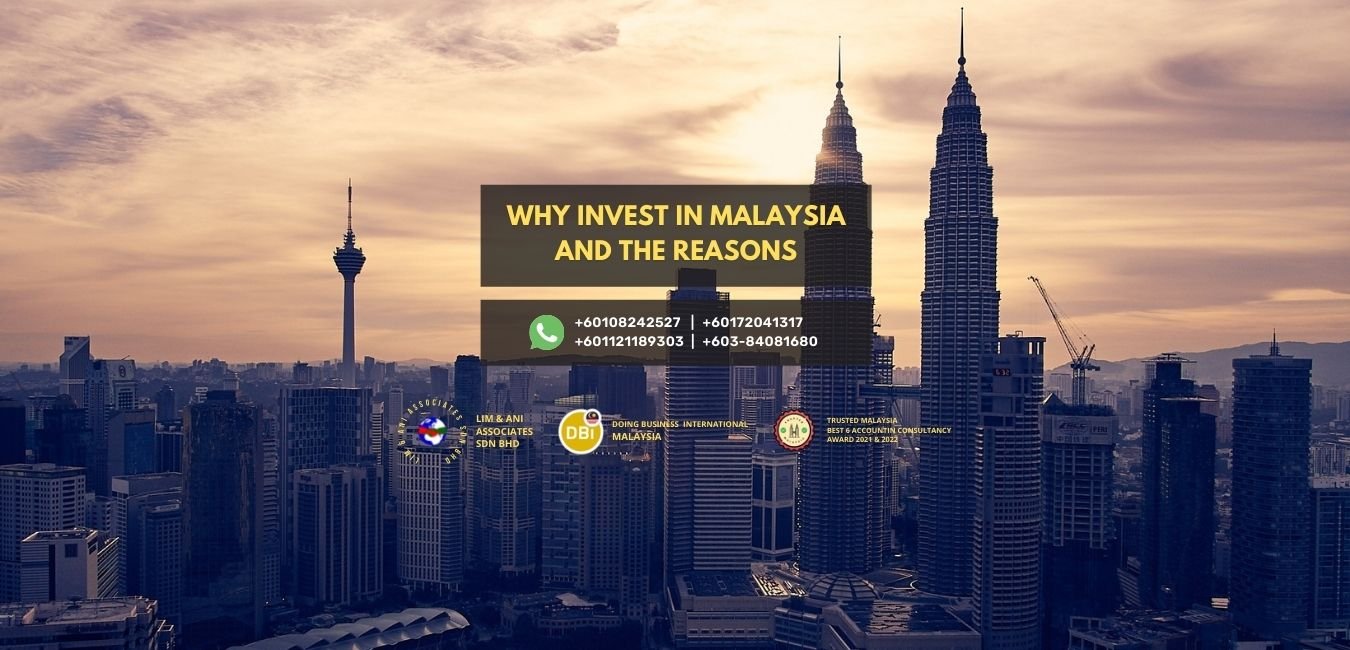
Why Invest in Malaysia?
Malaysia combines a diversified economy, strong regional connectivity, global trade integration, established financial markets and significant foreign-investment activity with access to the wider ASEAN region.
For an international entrepreneur or company, the real value of Malaysia is not one isolated incentive. It is the combination of location, infrastructure, manufacturing capability, services, talent, banking, trade access and a mature corporate framework.
Why Malaysia Still Matters to International Investors
Malaysia has evolved from a commodity-focused economy into a diversified business environment spanning services, manufacturing, technology, trade, construction, logistics, finance and other higher-value industries.
Malaysia’s official investment portal identifies strong economic fundamentals, policy reform, mature financial markets, regulatory stability and sustainability among the country’s major investment strengths.
Investors can use Malaysia not only as a domestic market, but also as a manufacturing, services, trading, digital and regional business base.
Foreign Investors Are Still Committing Capital to Malaysia
Malaysia recorded RM426.7 billion in approved investments in 2025, the highest level reported by MIDA for a full year.
These are approved-investment statistics reported by MIDA and should not be interpreted as guaranteed returns for an individual investment.
Investment Activity Continued Into 2026
For the first quarter of 2026, MIDA reported RM92.8 billion in approved investments across services, manufacturing and the primary sector.
Foreign investment represented RM56.2 billion, or 60.5% of the approved investment value reported for the quarter.
RM60.8 Billion
Services accounted for the largest share of Q1 2026 approved investment.
RM24.1 Billion
Manufacturing remained an important destination for new investment.
RM7.9 Billion
Primary-sector projects made up the balance of approved investment.
Strategic Location Inside ASEAN
Malaysia sits within one of the world’s most economically important regions and offers practical access to ASEAN markets together with strong links to China, the wider Asia-Pacific region, Europe and the Americas.
For businesses involved in manufacturing, distribution, trading, logistics or regional services, geography can translate directly into supply-chain and market-access advantages.
ASEAN Access
Position the Malaysian operation within a large and increasingly integrated regional market.
Asia-Pacific Links
Connect regional suppliers, customers and production networks.
Global Trade
Use Malaysia’s established export and import infrastructure to serve international markets.
Malaysia Is Deeply Integrated Into Global Trade
Malaysia’s total trade exceeded RM3 trillion for the first time in 2025, reaching RM3.061 trillion.
Exports reached a record RM1.607 trillion, while Malaysia recorded its 28th consecutive annual trade surplus.
MATRADE attributes the strong performance partly to Malaysia’s integration into technology-driven global supply chains and its trade relationships with ASEAN, the United States, the European Union and other major markets.
Malaysia Has a Diversified Economy
Diversification matters because an investor is not entering an economy dependent on one single business sector.
Malaysia’s GDP reached RM1.74 trillion in 2025 and expanded by 5.2%. Services and manufacturing together accounted for 82.5% of GDP.
59.5% of GDP
Services remained Malaysia’s largest economic sector in 2025.
Established Industrial Base
Manufacturing continued to support Malaysia’s domestic and export economy.
12.2% Growth
Construction recorded continued double-digit growth during 2025.
A Strong Services Economy Creates Multiple Entry Points
Malaysia’s services sector represented 59.5% of GDP in 2025 and expanded by 5.4%.
This gives foreign founders potential entry points beyond capital-heavy manufacturing projects, including professional, technology, trading and other service-oriented businesses.
Malaysia Has an Established Manufacturing Ecosystem
Malaysia has long-standing capabilities in manufacturing and global supply chains.
MIDA reported RM131.3 billion in approved manufacturing investments in 2025, of which RM100.6 billion came from foreign sources.
Electronics
Malaysia remains integrated into global electrical and electronic supply chains.
Industrial Products
Machinery, equipment and other manufactured goods contribute significantly to trade.
Value-Added Manufacturing
Policy increasingly emphasises technology, automation and higher-skilled production.
Malaysia’s Digital Investment Environment Is Expanding
Information and communication was a major contributor to Malaysia’s 2025 approved investment performance.
MIDA reported RM152.9 billion in approved investment within the information and communication sub-sector, driven in part by AI, big data, data centres and cloud computing.
Malaysia Has Developed Infrastructure
An investment environment depends on the ability to move people, goods, information and capital efficiently.
Ports
Malaysia’s port infrastructure supports regional and international trade.
Air Connectivity
International airports support passenger, commercial and cargo movement.
Road Networks
Major commercial and industrial centres are linked by extensive road infrastructure.
Industrial Areas
Malaysia has established industrial and manufacturing locations across multiple states.
Digital Infrastructure
Connectivity and digital infrastructure support technology and services businesses.
Commercial Centres
Kuala Lumpur, Selangor, Johor, Penang and other locations provide different operating environments.
Malaysia Has a Mature Financial Market
Malaysia’s official investment platform identifies its mature financial market as one of the country’s core investment advantages.
For businesses, this broader ecosystem includes established domestic and international banks, capital markets and financial institutions.
Foreign-owned companies still need to satisfy bank KYC, AML, source-of-funds and commercial onboarding requirements.
Malaysia Has a Structured Legal and Regulatory Framework
InvestMalaysia highlights Malaysia’s stable regulatory environment and governance framework as one of the country’s investment strengths.
For an investor, predictable company law, defined licensing authorities, tax administration and established corporate institutions can provide a clearer operating environment than jurisdictions with less developed systems.
Company incorporation, business licensing, banking, tax and sector approvals should be planned together rather than handled as disconnected tasks.
Malaysia Supports Multiple Types of Foreign Investors
Malaysia is not only a destination for multinational factories. Different types of investors can use different entry models.
New Business
Establish a new Malaysian company around a validated business model.
Regional Expansion
Use Malaysia as part of a wider ASEAN or Asia-Pacific expansion strategy.
Existing Business Acquisition
Acquire or invest in an existing Malaysian operation after proper due diligence.
Can a Foreigner Own 100% of a Malaysian Company?
Many Malaysian Sdn. Bhd. structures can have 100% foreign shareholding. However, that should not be interpreted as a universal rule for every regulated or licensed business activity.
Certain activities can have sector-specific licensing, capital, local-participation or approval conditions.
The correct question is not simply whether a foreigner can own a company, but whether that company can operate the proposed business under the intended ownership and licensing structure.
A Malaysian Sdn. Bhd. as an Investment Vehicle
A Malaysian private company limited by shares can provide a formal corporate vehicle for business operations, investment, employment, contracts and corporate banking.
Shareholders
Define ownership and capital participation.
Directors
Establish management while satisfying the applicable resident-director requirement.
Company Secretary
Maintain Malaysian statutory corporate administration.
Registered Office
Maintain the required Malaysian registered-office structure.
Business Activities
Register activities that match what the company will actually do.
Paid-Up Capital
Plan capital around business, licensing, banking and operational requirements.
Malaysia’s Trade Agreements Can Support International Business
Malaysia participates in major regional trade frameworks including RCEP and CPTPP, in addition to other trade agreements.
MATRADE notes that these agreements continue to support market access and export diversification for Malaysian businesses.
Rules of origin, product classification and the conditions of the applicable trade agreement should be checked for the actual transaction.
What Types of Businesses Can Investors Evaluate?
Different Malaysian States Serve Different Investment Needs
Malaysia should not be treated as one uniform business location. Industry clusters, customers, property costs, workforce, logistics and state-level ecosystems vary considerably.
Business Decisions Also Depend on Where Founders Can Live and Operate
For entrepreneurs relocating with their businesses, Malaysia offers large urban centres, international schools, private healthcare, multicultural communities and established transport infrastructure.
These factors can matter when a founder or senior management team expects to spend significant time operating the Malaysian business.
A sound investment should still stand on customer demand, economics, licensing and execution.
Why Malaysia May Not Be Right for Every Business
A credible investment guide should also explain where the structure can fail.
Malaysia is attractive when the business model fits the Malaysian market and regulatory structure. It is not automatically the best jurisdiction for every company or investor.
What Should a Foreign Investor Check Before Entering Malaysia?
Identify exactly what the company will sell, manufacture or provide.
Confirm customers and commercial opportunity.
Determine whether the proposed ownership structure works for the activity.
Identify applicable sector and local approvals.
Budget real operating capital rather than incorporation cost alone.
Establish shareholders, directors and business activities.
Build a clear KYC and source-of-funds profile.
Secure premises, suppliers, staff and commercial contracts where required.
Prepare accounting, taxation and statutory administration.
Expand only after the Malaysian operating model is validated.
Foreign Investor Mistakes to Avoid
Choosing Malaysia Only for Low Cost
The real opportunity is market access and operating capability, not simply cheap incorporation.
Assuming Every Sector Allows the Same Ownership
Check the actual business activity before fixing the shareholding.
Ignoring Licences
SSM incorporation does not replace operating approvals.
Expecting Automatic Banking
Banks conduct independent KYC and commercial review.
Confusing Investment With Immigration
Company ownership and permission to work or reside in Malaysia are separate issues.
Believing Guaranteed Profit Claims
Malaysia can provide opportunity, but individual business returns remain dependent on execution.
Malaysia Investment & Market-Entry Advisory
We assist foreign founders and international businesses in structuring the Malaysian corporate and operational side of their market entry.
Continue Your Malaysia Investment Research
Investment Opportunities in Malaysia
Explore sectors and current areas of investment activity.
Investment Opportunities →Invest in Malaysia
Read the broader foreign-investor and market-entry guide.
Malaysia Investment Guide →Malaysia Business Setup
Understand company registration, licensing, banking and operations.
Business Setup Guide →Profitable Business in Malaysia
Understand how to evaluate and structure a commercially viable Malaysian business.
Business Planning Guide →Considering Malaysia for Your Next Business or Investment?
Tell us your nationality, proposed activity, expected investment, ownership structure and whether you intend to manufacture, trade, provide services or acquire an existing Malaysian business.
We can help determine whether the corporate, licensing, banking and operational structure works before major capital is committed.