
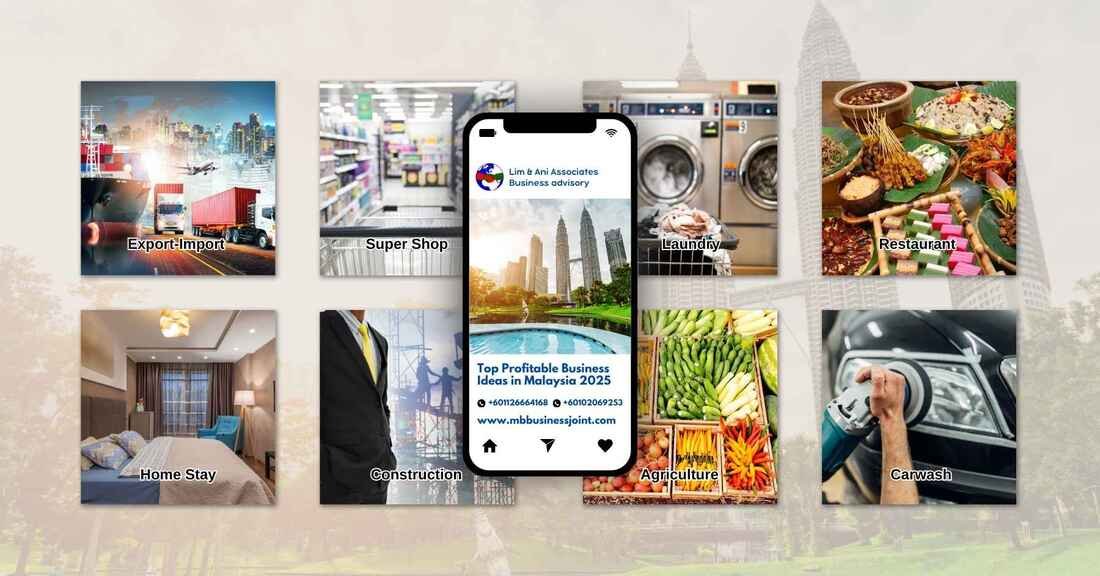
Top 15 Profitable Business Ideas in Malaysia for Foreigners (2026 Guide)
Malaysia continues to attract international entrepreneurs looking for an ASEAN operating base, 100% foreign ownership opportunities in suitable sectors, access to regional supply chains and a growing digital economy.
But the best business is not simply the industry with the biggest headline. A viable Malaysia business must match your capital, experience, customer demand, foreign-ownership structure, licensing requirements and ability to operate it properly.
This article was originally built around Malaysia’s 2025 opportunity landscape. It has now been fully rebuilt around current 2026 market conditions, foreign-founder considerations and Malaysia’s latest investment direction.
Why Malaysia Remains Attractive for Foreign Entrepreneurs
Malaysia combines a relatively sophisticated business environment with access to ASEAN, international ports and airports, established banking, manufacturing supply chains, multilingual talent and a rapidly developing technology ecosystem.
Q1 2026 approved investment reached RM92.8 billion. Services accounted for RM60.8 billion, while foreign investment represented RM56.2 billion.
Regional Market Position
Malaysia can serve as a commercial base for Southeast Asian and wider Asia-Pacific business.
Foreign Equity Opportunities
Many business activities can support significant or complete foreign ownership, subject to sector-specific requirements.
Operational Ecosystem
Ports, airports, industrial parks, commercial centres and digital infrastructure support multiple business models.
Regional Growth Platform
International founders can use Malaysia as part of a wider ASEAN expansion strategy.
Malaysia’s Digital Investment Boom Changes the Opportunity Map
Information and communications attracted RM38.9 billion of approved investment in Q1 2026. Data centres and cloud computing represented RM34.6 billion across 33 projects.
Small and medium founders should not interpret this as a reason to build data centres themselves. The more practical opportunity is supplying the software, cybersecurity, automation, engineering, consulting and other services that a growing digital economy requires.
What Makes a Business Opportunity Attractive?
“Profitable” does not mean guaranteed profit. These opportunities are selected because they can offer commercially viable entry points when demand, execution and regulatory structure are right.
AI, Software & Technology Services
Technology is one of the strongest strategic opportunities in Malaysia entering 2026.
Rather than competing directly with hyperscale infrastructure, entrepreneurs can build products and services around the growing demand for digital transformation.
A specialised B2B technology company can potentially serve Malaysian, ASEAN and international customers from the same operating base.
Import, Export & General Trading
Malaysia’s location and established logistics ecosystem can make it an attractive base for businesses sourcing products in Asia and selling into ASEAN, South Asia, the Middle East or other international markets.
Customs, product approvals, distributive-trade conditions and specialised licences can depend on what is actually being traded.
E-Commerce & Cross-Border Online Business
E-commerce allows founders to test products without immediately committing to an expensive physical retail footprint.
Combine marketplace exposure with your own website and customer database rather than building the entire business around one platform.
Consulting & Professional Business Services
Service businesses can be attractive because they often require less inventory and physical infrastructure than retail or manufacturing.
The strongest model is usually specialised expertise sold to a defined customer segment—not a generic “consulting company” with no clear commercial niche.
Wholesale & Distribution Business
Malaysia’s domestic and regional commercial networks create opportunities for specialised distributors connecting manufacturers, importers, retailers and corporate buyers.
Distributive-trade activities can involve additional foreign-equity, licensing or regulatory considerations depending on the structure.
Restaurant, Café & Food Business
Malaysia’s multicultural food market creates room for differentiated restaurant concepts, international cuisines, catering operations and specialised food brands.
Location, rent, labour, food cost, licensing, local-authority approvals and repeat customers can matter more than the concept itself.
Logistics & Supply-Chain Services
Trading, manufacturing and e-commerce all create demand for logistics and supply-chain support.
Founders do not necessarily need to own trucks or warehouses. There are asset-light opportunities in coordination, technology, procurement and specialised supply-chain services.
Electrical & Electronics Supply-Chain Services
Malaysia has a long-established electrical and electronics manufacturing ecosystem.
New entrepreneurs do not need to fabricate semiconductors themselves. More realistic opportunities can exist around suppliers and supporting services.
Manufacturing & Contract Manufacturing
Manufacturing can provide a strong Malaysia investment case when the founder has genuine products, technical expertise, supply relationships or export markets.
Malaysia permits 100% foreign equity in new manufacturing projects and eligible expansion/diversification projects, subject to the applicable regulatory framework.
Construction & Technical Services
Construction opportunities are not limited to becoming a large property developer.
CIDB and other project, contractor or technical requirements should be mapped before accepting work.
Cleaning & Facility Management Services
Recurring service contracts can make cleaning and facility support attractive where the company develops reliable staffing, quality control and customer retention.
Cleaning Business Guide →Tourism & Hospitality Services
Tourism creates opportunities beyond hotels. Travellers consume transport, food, experiences, accommodation and support services.
The correct licensing structure depends heavily on the actual activity, so “tourism company” should not be treated as one generic licence.
Digital Marketing, Content & Creative Services
Companies increasingly need video, social media, design, performance advertising, content systems and digital brand support.
Sell measurable commercial outcomes to a specific client category rather than being another general-purpose marketing agency.
Corporate Training & Skills Development
Businesses need continuously updated skills in AI, technology, cybersecurity, management, sales, compliance and technical disciplines.
Formal education institutions can face substantially different licensing requirements from ordinary corporate training providers.
Green Technology & Sustainability Services
Sustainability requirements and energy transition can create business opportunities well beyond owning renewable-generation assets.
A practical SME opportunity can be providing technology, engineering, measurement, compliance or operational services to larger companies implementing sustainability programmes.
Which Business Model Is Easier to Start?
| Business Model | Capital Intensity | Operational Complexity | Licensing Exposure |
|---|---|---|---|
| Software / AI Services | Lower to Medium | Medium | Generally Lower* |
| Consulting | Lower | Lower to Medium | Depends on profession |
| E-Commerce | Lower to Medium | Medium | Product dependent |
| Import / Export | Medium to High | Medium to High | Product dependent |
| Restaurant | Medium to High | High | High |
| Manufacturing | High | High | High |
*The exact regulatory position depends on the activity. This table is a practical comparison, not a licensing determination.
Can a Foreigner Start These Businesses in Malaysia?
Foreign investors can establish Malaysian companies, and many activities can support full foreign ownership. But foreign ownership should never be assumed solely from the fact that SSM can incorporate the company.
Specific approvals, licences, registrations or sector requirements may impose their own foreign-equity or operating conditions.
How Much Money Do You Need to Start a Business in Malaysia?
There is no reliable universal figure.
An AI consulting company, restaurant, importer and manufacturer can have radically different capital requirements.
Incorporation and corporate administration.
Sector and local-authority approvals where required.
Office, shop, warehouse or production facility.
Stock and raw materials where applicable.
Recruitment, payroll and employment costs.
Cash required until customers begin paying reliably.
Software, equipment and operational systems.
Accounting, tax, secretarial and ongoing obligations.
Calculate capital after defining the actual business, licence, operating model and runway required to reach sustainable revenue.
Which Business Should You Choose?
From Business Idea to Operating Malaysian Company
Two Different Stages: Decide First, Execute Second
Malaysia Entry Readiness Sprint™
For founders who are still deciding the correct business, structure, ownership, licensing and capital pathway.
- Business-model assessment
- Foreign ownership review
- Licensing pathway assessment
- Banking-readiness considerations
- Commercial structure planning
Malaysia Launch FastTrack™
For founders who already know they are proceeding and need the corporate setup and operational-readiness pathway executed.
- Malaysia company incorporation
- Company-secretarial framework
- Registered-office support
- TIN and compliance readiness
- Foreign-founder operational setup
Malaysia Business Setup Resource Hub
Starting a Business in Malaysia — Quick Answers
What is the best business to start in Malaysia in 2026?
There is no universal best business. AI and technology, international trading, e-commerce, B2B services, distribution, logistics and selected manufacturing activities are among the opportunities worth evaluating, but the right choice depends on experience, customers, capital and licensing.
Can foreigners own 100% of a Malaysian company?
Full foreign ownership is possible in many activities, but certain regulated sectors, licences and approvals can impose additional equity or operating requirements.
How much money do I need to start a business in Malaysia?
There is no universal startup figure. A software consultancy can have very different capital needs from a restaurant, importer, distributor or factory. Capital should be planned around the actual operation.
Does company registration automatically allow me to operate?
Not always. Some businesses require local-authority, sector, product, premises or other regulatory approvals after incorporation.
Can a Malaysian company guarantee me a business bank account?
No. Corporate bank-account approval remains subject to the bank’s independent KYC, AML and commercial-risk assessment.
Does owning a Malaysian company automatically give me a business visa?
No. Company ownership and permission to work or reside in Malaysia are separate issues and must be assessed through the appropriate immigration or expatriate pathway.
Should I choose the business before registering the company?
Yes. The business activity can affect foreign ownership, licensing, paid-up capital, premises, banking and future immigration planning.
2026 Data & Regulatory Sources
Current market data and regulatory assumptions in this guide should always be checked against the relevant Malaysian authority before capital is committed.
Found the Business Idea? Now Validate the Structure Before You Invest.
The wrong sequence is registering a company first and discovering the licensing, banking or ownership problems later.
We assist foreign founders with Malaysia market-entry structuring, company incorporation, banking readiness, licensing coordination, accounting, tax and longer-term business planning.