
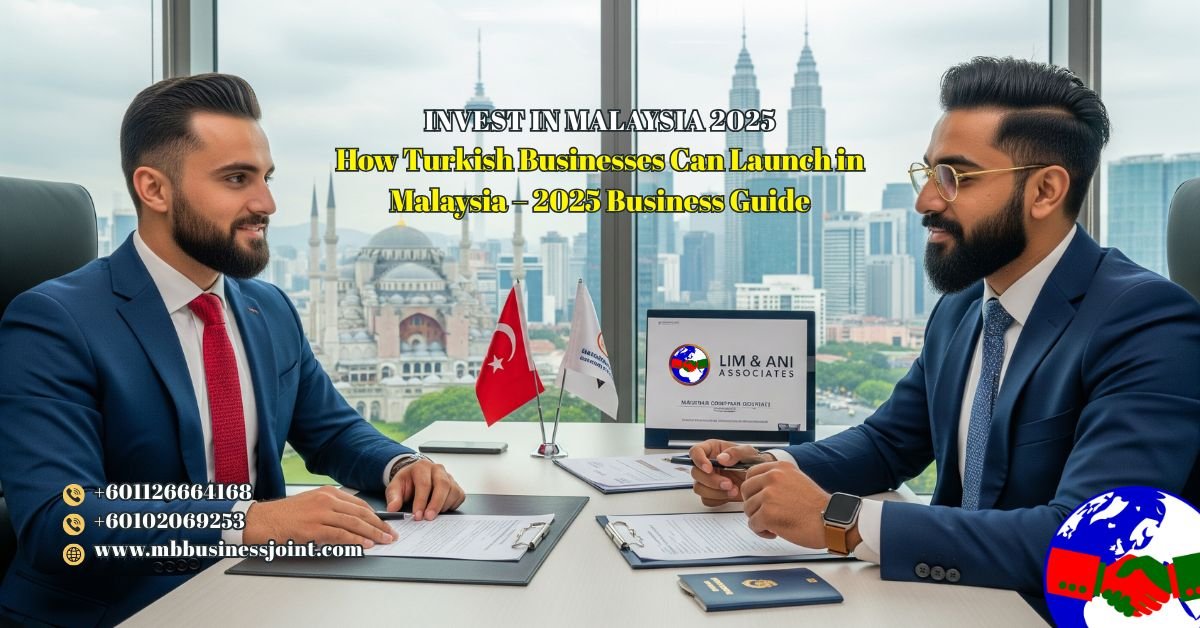
Malaysia Company Setup for Turkish Entrepreneurs 2026 Business Expansion Guide
For Turkish founders looking beyond Europe and the Middle East, Malaysia can provide a strategic operating base inside ASEAN — with opportunities across trade, technology, manufacturing, halal industries, engineering and regional services.
This guide explains how Turkish individuals and companies can establish a Malaysian business, structure foreign ownership, prepare for corporate banking and plan the correct expatriate pathway.
From Türkiye to ASEAN: Build a Real Malaysian Operating Base
Malaysia and Türkiye occupy complementary commercial positions. Türkiye connects Europe, Central Asia and the Middle East, while Malaysia provides direct access to Southeast Asia and the wider ASEAN economy.
For the right Turkish business, establishing in Malaysia can therefore be more than foreign company registration — it can become a regional expansion strategy.
Why Malaysia Makes Strategic Sense for Turkish Businesses
Malaysia combines a developed corporate infrastructure with direct participation in ASEAN and strong links to international markets. It can be particularly relevant to Turkish businesses seeking an Asian operating presence rather than merely an overseas registration.
ASEAN Gateway
Establish a commercial base within one of the world’s important regional economic blocs.
Foreign Ownership
100% foreign ownership is possible across many activities, subject to sector and licensing rules.
Halal Economy
Malaysia provides an established halal ecosystem for qualifying food, manufacturing and consumer businesses.
Regional Operations
Use Malaysia for trading, technology, manufacturing, services and regional commercial operations.
Malaysia and Türkiye Already Have an Investment Bridge
Malaysia’s investment agency MIDA operates an Istanbul office designed to facilitate investment and commercial collaboration between Malaysia and Türkiye.
This gives Turkish investors something important: Malaysia is not an unfamiliar or disconnected market. There is an established institutional pathway supporting bilateral investment.
Industrial and equipment opportunities.
Technology and industrial collaboration.
Software, technology and digital investment.
Food manufacturing and halal-market opportunities.
Türkiye can connect Malaysian businesses toward Europe, Central Asia and the Middle East, while Malaysia can provide Turkish businesses with a platform toward ASEAN.
Can Turkish Citizens Own 100% of a Malaysian Company?
In many Malaysian business activities, a Turkish individual or Turkish corporate shareholder can potentially own 100% of a Malaysian Sdn. Bhd.
There is no universal rule requiring every foreign-owned Malaysian company to have a Malaysian shareholder.
Can potentially hold the shares directly.
Corporate ownership can also be structured where appropriate.
Malaysian operating company.
Foreign-equity conditions, paid-up capital, licences and regulatory approvals can vary depending on what the company actually does. The business activity should therefore be reviewed before incorporation.
What Is Required to Establish the Malaysian Company?
Where Turkish Businesses Can Find Opportunities in Malaysia
Food & Halal
Food manufacturing, Turkish products, distribution, restaurants and halal-market opportunities.
Machinery
Industrial equipment, engineering products, manufacturing technology and B2B supply.
ICT & Software
Software development, SaaS, AI, digital services, cybersecurity and technology operations.
Construction
Engineering, specialist contracting, building products and infrastructure-related services subject to licensing.
Furniture & Interiors
Turkish furniture, home products, commercial interiors and regional distribution.
Textiles
Fashion, fabrics, home textiles, wholesale and regional sourcing opportunities.
Trade & Logistics
Import-export, regional distribution, supply chain and cross-border commerce.
Professional Services
International consulting and business services where the activity and professional rules permit.
Malaysia Can Be More Than a Domestic Market for Turkish Halal Products
Turkish food and consumer brands may view Malaysia not only as a destination market, but also as a potential Southeast Asian platform.
Companies should assess the applicable Malaysian halal, food-safety, import and product-registration requirements for the specific product before making certification claims.
Build a Bankable Malaysian Company — Not Just an Incorporated Company
Corporate bank onboarding is a separate process from SSM incorporation. Banks conduct their own KYC, AML, source-of-funds and commercial reviews.
The objective should be to present a commercially credible, properly documented Malaysian operation that can withstand normal bank due diligence.
Can the Turkish Founder Live and Work in Malaysia?
Company ownership and permission to work in Malaysia are separate matters. A Turkish shareholder does not automatically obtain an Employment Pass simply because they own a Malaysian company.
Where the company and proposed position qualify, the appropriate expatriate pathway can be assessed. For companies under the ESD framework, Malaysia’s revised Employment Pass salary policy took effect on 1 June 2026.
Salary is only one component of the Employment Pass framework. Company eligibility, position, applicable approving authority, supporting documentation and other requirements still matter.
Türkiye → Malaysia Business Setup Process
Can Turkish Founders Start the Process Without Being in Malaysia?
Corporate onboarding and much of the incorporation process can generally be coordinated remotely, subject to proper KYC and documentation.
Banking, licensing or other processes can still require additional verification or physical attendance depending on the institution and circumstances.
Common Foreign-Investor Setup Mistakes
Incorporating before checking licences, banking and commercial requirements.
Using an activity that does not properly represent the actual business.
Building a paper company around an immigration objective instead of a business.
Failing to prepare source-of-funds and commercial evidence.
Discovering regulatory conditions only after incorporation.
Each country still has its own tax, customs and regulatory requirements.
Structured Malaysia Entry for Foreign Founders
The appropriate setup depends on whether you need a corporate foundation, operational readiness or a more advanced technology and investment structure.
Foreign Founder Entry
RM10,500Structured Malaysian company foundation for foreign entrepreneurs.
FastTrack™ Pro
RM16,900Broader setup for founders building an operational Malaysian presence.
Advanced Entry
RM24,900Advanced pathway for technology, investment and complex structures.
Package scope depends on the engagement and business requirements. Government, immigration, regulatory, banking and third-party charges may apply separately.
Compare Malaysia Launch FastTrack™ Packages →Malaysia Company Setup FAQ for Turkish Entrepreneurs
Can a Turkish citizen register a company in Malaysia?
Yes. Turkish individuals and companies can establish Malaysian companies, subject to the applicable corporate, sector and licensing requirements.
Can a Turkish entrepreneur own 100% of the company?
100% foreign ownership is possible in many Malaysian business activities. Sector-specific equity or licensing requirements should still be checked.
Do I need a Malaysian shareholder?
There is no universal requirement for every Malaysian Sdn. Bhd. to have a Malaysian shareholder. The relevant sector rules must be assessed.
Do I need a Malaysian resident director?
A Malaysian private company requires at least one director who ordinarily resides in Malaysia and has a principal place of residence in Malaysia.
Can a Turkish company own the Malaysian subsidiary?
Corporate shareholding can be structured where appropriate, subject to KYC, beneficial-ownership and sector requirements.
Can I open a Malaysian corporate bank account?
A Malaysian company can apply for corporate banking, but approval remains subject to the bank’s independent KYC, AML and commercial assessment.
Does company ownership automatically give me an Employment Pass?
No. Company ownership and Employment Pass approval are separate processes.
What are Malaysia’s Employment Pass salary thresholds in 2026?
From 1 June 2026, the revised thresholds are RM20,000 and above for Category I, RM10,000–RM19,999 for Category II, and RM5,000–RM9,999 for Category III, subject to the applicable requirements.
Is Malaysia suitable for Turkish halal businesses?
Malaysia can be attractive for qualifying food manufacturing, distribution and halal-focused businesses, but product, import, food-safety and halal requirements must be assessed for the particular operation.
Can I start the Malaysia company process from Türkiye?
Much of the corporate onboarding and incorporation process can generally be coordinated remotely. Banking and other regulated processes can have separate verification or attendance requirements.
Primary Sources for Further Verification
Expanding From Türkiye to Malaysia? Build the Structure Before You Commit the Capital.
We support foreign founders and international companies with Malaysia company establishment, corporate structuring, banking readiness, licensing coordination, accounting and tax readiness, ESD preparation and long-term operational setup.