
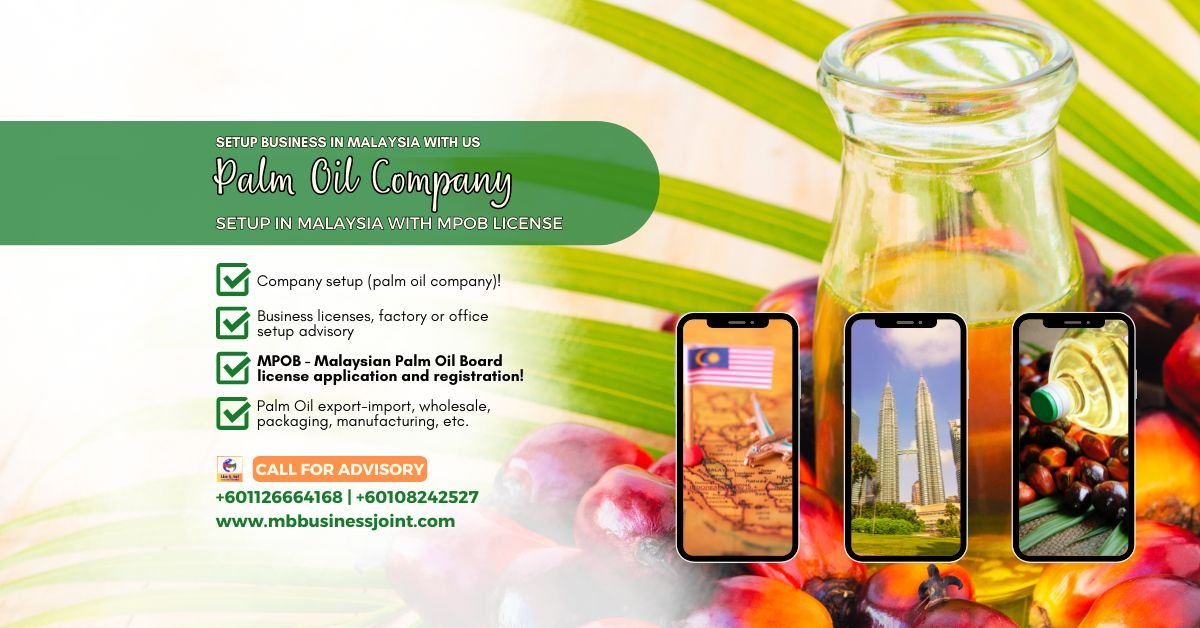
How to Start a Palm Oil Business in Malaysia: Complete 2026 MPOB Guide
Malaysia’s palm oil industry offers opportunities across plantation, trading, services, manufacturing and export—but each business model has a different licensing, capital and operational pathway.
The correct starting point is not simply “register a company.” First determine which part of the palm oil value chain you intend to enter, then structure the company, MPOB licence, premises, banking, contracts and compliance around that activity.
Why Palm Oil Remains an Important Malaysian Business Sector
Malaysia has a mature palm oil ecosystem covering cultivation, milling, refining, trading, logistics, oleochemicals, biomass, food ingredients and export.
For a new investor, the opportunity is not limited to owning a plantation. A business can enter the value chain through trading, storage, transport, processing, manufacturing, export or specialised services.
A palm oil trader, estate operator, transporter and manufacturer may all work in the same industry while facing completely different licensing, capital, premises and operating requirements.
Four Main Palm Oil Business Sectors
MPOB identifies four broad sectors for business participation: plantation, trading, services and manufacturing.
Plantation
Cultivation of oil palm and sale or movement of fresh fruit bunches.
Trading
Buying, selling, storing, transferring, importing or exporting regulated oil palm products.
Services
Transport, storage, testing, inspection and other industry-support activities.
Manufacturing
Processing and manufacturing palm-derived products, ingredients, oleochemicals or biomass-based products.
Set Up the Correct Malaysian Company Structure
For a commercial palm oil operation, a Malaysian Sdn. Bhd. is commonly used to hold contracts, licences, employees, premises and banking.
Shareholders
Structure ownership based on the intended business activity and applicable regulatory requirements.
Directors
Ensure the company satisfies Malaysian director requirements.
Business Nature
The company’s stated activities should match the palm oil business actually being conducted.
Company Secretary
Maintain ongoing statutory company administration.
SSM establishes the company. MPOB licensing is a separate regulatory step for controlled palm oil activities.
MPOB Licensing: The Core Regulatory Layer
The Malaysian Palm Oil Board regulates licensing activities involving oil palm products under the Malaysian Palm Oil Board Act and related regulations.
MPOB’s licensing functions cover activities including cultivation, sale, purchase, production, transfer, storage, inspection, testing, exportation, importation and manufacture of oil palm products.
Do not apply for a generic “palm oil licence.” MPOB licensing is activity-specific and product-specific.
How Long Does an MPOB Licence Take?
MPOB’s current FAQ states that most licence categories are processed within up to 30 working days once the application satisfies the required criteria.
Processing time should never be treated as a guaranteed approval date. Incomplete documents, premises issues or unmet criteria can delay or prevent approval.
Palm Oil Trading Business
Trading is often the most accessible commercial entry point for investors who do not want to own plantations or manufacturing facilities.
Domestic Trading
Purchase and sale of regulated palm oil products within Malaysia.
B2B Supply
Supply refiners, manufacturers, distributors or industrial customers.
Export Trading
Sell Malaysian palm oil products to international buyers subject to licensing and export requirements.
Import Trading
Import regulated oil palm products where the business model and licence structure permit it.
Working capital, payment terms, inventory exposure, commodity-price movement and bank trade facilities can matter more than the basic company-registration cost.
Starting a Palm Oil Export Business
An export operation needs more than an overseas buyer and a Malaysian company. The exporter should understand the exact palm product, destination market, MPOB licensing, customs documentation and contractual terms.
MPOB operates an e-Registration framework for applicable oil palm product trade contracts. Businesses should build regulatory reporting into their trading workflow rather than treating it as an afterthought.
Oil Palm Plantation Business
Plantation is very different from commodity trading because it is land-, labour- and time-intensive.
Land
Ownership, lease rights, land use and location must support cultivation.
Planting
Oil palm requires agricultural planning, seedlings, fertilisation and estate management.
Harvest
Fresh fruit bunches require reliable harvesting and transport.
MPOB
Applicable estate or smallholding licensing should be established.
The investor should model land cost, planting, labour, fertiliser, maintenance, yield, transport and commodity-price cycles over a longer investment horizon.
Palm Oil Processing & Manufacturing
Manufacturing can create more value than basic commodity trading, but it also raises the capital and compliance requirement significantly.
Food Ingredients
Refined or specialised palm-derived ingredients for food production.
Oleochemicals
Palm-derived chemicals and downstream industrial products.
Biofuel
Selected palm-derived fuel and energy applications.
Palm Biomass
Value-added use of empty fruit bunches, fibres, shells and other biomass.
MIDA continues to highlight palm biomass as an investment area, including renewable power generation, bio-pellets, advanced biofuels and biochemical products. :contentReference[oaicite:2]{index=2}
Palm Biomass & Downstream Innovation
Palm oil opportunities increasingly extend beyond crude commodity trading. Malaysia’s existing palm industry creates significant biomass streams that can support higher-value industrial projects.
Premises, Storage and Logistics
The required premises depend heavily on the licence class. A pure commercial office, storage operation, processing facility and plantation all have different operating requirements.
The location and physical setup should support the MPOB licence and local operating requirements that apply to the intended activity.
Sustainability, Certification & Buyer Requirements
Sustainability is commercially important in palm oil, particularly for exports and multinational supply chains.
However, certification schemes should not be confused with statutory company or MPOB licensing.
MPOB
MPOB licensing covers regulated palm oil activities under Malaysian law.
Certification Frameworks
Certification and buyer standards may be required commercially depending on the customer, product and destination market.
Exporters should establish which certification or traceability standards their intended customers require before sourcing product.
Palm Oil Trading Contracts Need Commercial Discipline
Commodity trading exposes businesses to price, quantity, quality, delivery and payment disputes.
Banking Is Critical in Palm Oil Trading
A palm oil trader can have a valid company and MPOB licence but still struggle commercially without adequate working capital and banking support.
The objective is to structure a transparent business profile with real suppliers, buyers, contracts and funding evidence so the bank can assess the application properly.
Can Foreigners Start a Palm Oil Business in Malaysia?
Foreign investors can establish Malaysian companies, but the proposed ownership structure should be reviewed against the actual palm oil activity, MPOB requirements and any other applicable sector conditions.
Set up the appropriate Malaysian entity.
Identify the licence class needed for the intended business.
Plan genuine operating capital rather than incorporation capital only.
Establish the location or facility required by the activity.
Prepare a transparent corporate and trade profile.
Share ownership does not automatically give a foreign founder permission to work in Malaysia.
How Much Does It Cost to Start a Palm Oil Business?
There is no responsible universal startup figure because a trading office, warehouse operation, plantation and processing plant have completely different capital requirements.
Corporate structure and professional setup.
Applicable licence and application costs.
Office, storage, factory or plantation depending on activity.
Product purchase and storage costs.
Transport, port, storage and delivery.
Cash required between purchase and customer settlement.
Commercial and trade-finance readiness.
Accounting, tax, audit and ongoing regulatory costs.
Is Palm Oil Trading Profitable?
It can be, but commodity volume alone does not guarantee profit.
A business can generate high revenue and still have poor returns if commodity margin is thin or financing and logistics costs are not controlled.
Main Risks in Palm Oil Business
Price Volatility
Commodity price movements can rapidly change trading margins.
Counterparty Risk
A profitable contract is worthless if the buyer or supplier does not perform.
Quality Disputes
Poor product specifications or testing controls can create claims.
Licence Mismatch
The company may have an MPOB licence that does not cover the real activity.
Working Capital
Large purchase commitments can create severe cash-flow pressure.
Export Compliance
Destination-market documentation and requirements can affect shipment.
How to Start the Business Properly
Palm Oil Business Mistakes to Avoid
“Register Company First”
The MPOB activity should be mapped before fixing the operating structure.
Calling RSPO a Government Licence
Sustainability certification and Malaysian statutory licensing are different layers.
Buying Stock Without Buyer
Commodity inventory should not be accumulated without a real commercial plan.
No Working Capital
Palm trading can require significant cash between purchase and settlement.
Weak Contracts
Price, quality, quantity and delivery should be clearly documented.
Assuming Bank Finance
Trade facilities remain subject to independent bank underwriting.
Planning a Palm Oil Business in Malaysia?
Start by identifying where you will sit in the palm oil value chain. A trader, plantation operator, exporter and manufacturer require different structures and should not be built from the same generic template.
We assist local and foreign founders with the corporate and business setup framework around Malaysian palm oil operations and coordinate specialist licensing work where required.